Photo search quote
Have a product photo? Send it for a supplier quote.
Seen a product you like but do not know where to buy it? Upload the clearest image first, or send the brand reference, model name, SKU, Yupoo link, or social screenshot. We compare exact and close China supplier options, then continue price, quantity, shipping, and after-sales details on WhatsApp.
Any brand or model name identifies the buyer reference only. ReplicaChina does not claim brand affiliation, provenance, permanent inventory, or fixed pricing.
- Image first
- No product name required.
- Supplier check
- Exact match first, close alternatives second.
- Fast quote
- Continue with price and shipping on WhatsApp.
Last updated: 2026-09-02 · Reviewed by the ReplicaChina sourcing team
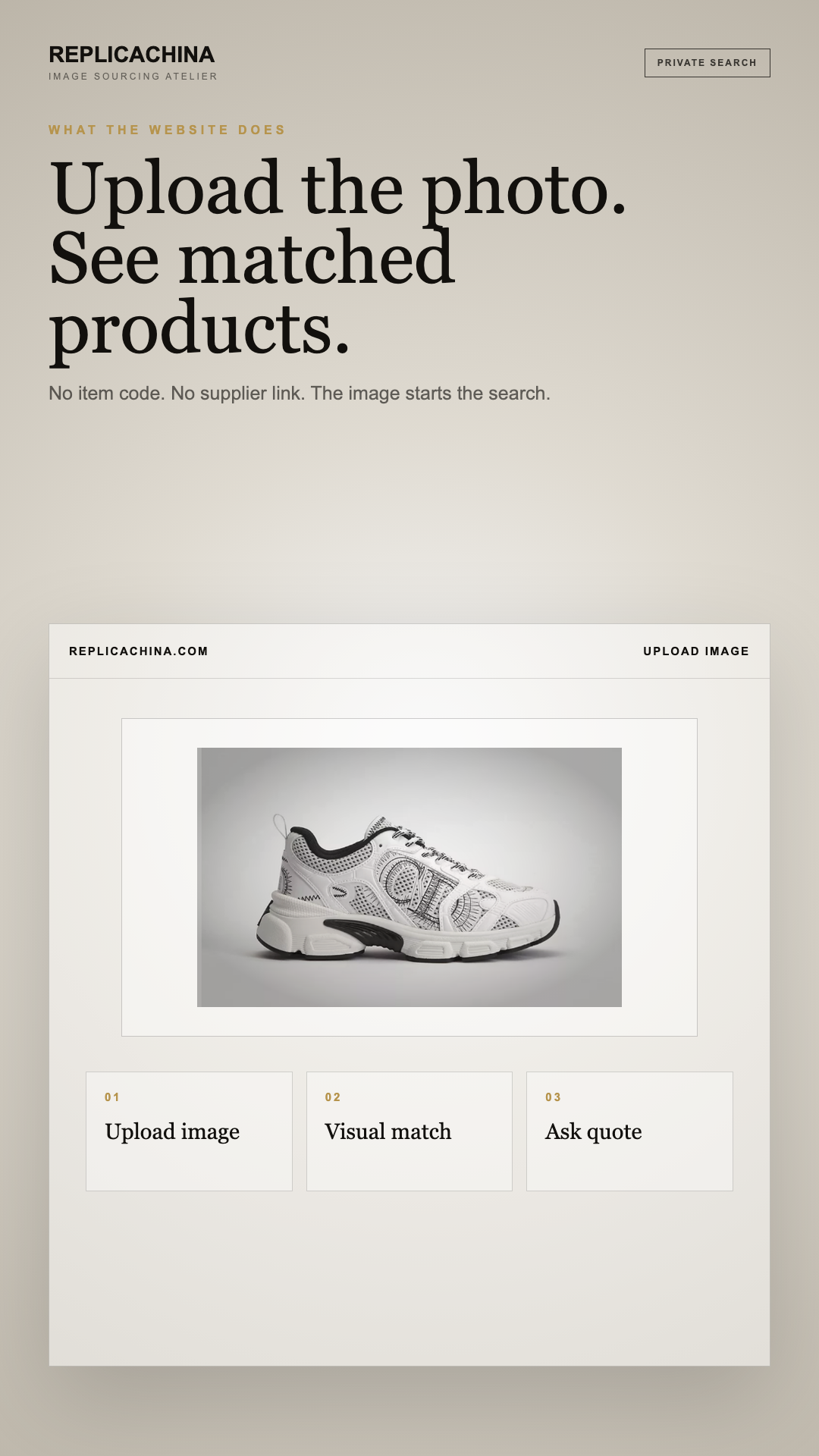
Direct answer: Use native Yupoo image search inside an owner-enabled, synchronized album and understand exactly what the result can and cannot establish. A usable outcome also depends on this step: Confirm the owner enabled and synchronized native image search. Avoid assuming image search is enabled across every album or proves current stock; close the record as unresolved when the necessary evidence is unavailable.
Independent-use notice: ReplicaChina is independent and is not affiliated with, endorsed by, or operated by Yupoo or any other platform named here. Names and trademarks belong to their respective owners. Album references identify a buyer request only; confirm product legality, rights, seller identity, and transaction terms for the destination.
The practical task is to use Yupoo's native image-search feature where the album owner has enabled it. Work from a clean reference image and an enabled, synchronized album search surface and keep the main failure visible: assuming image search is enabled across every album or proves current stock. The finished record should make search scope, result source album, visual match quality, item status, and remaining search attempts reviewable without borrowing facts from an unrelated image, seller, or route.
Confirm native search scope
Native Yupoo image search is album-scoped, so show where each search operates. Identify the album owner, confirm that image search is enabled, and record whether older material has been synchronized. A search in one enabled album should not be described as a search of every Yupoo account. Add a scope label to each example, stating whether the result came from the owner’s album, another enabled album, or a separate open-web fallback. This makes no-result outcomes understandable.
Prepare images without erasing evidence
Image preparation affects discovery quality but must not erase evidence. Save the original file and source, then make a separate search copy. Remove broad social overlays only when they obscure the product, retain visible codes and construction details, and test alternate angles individually. Explain why a side view may reveal shape while a label or hardware close-up may surface a different candidate. Document the image, search date, and result URL so another reviewer can reproduce the attempt.
Treat a match as a scoped lead
A native match is a lead inside a defined album, not proof of origin or a current offer. Compare caption, item code, proportions, color, details, and category placement with the reference. If a required feature differs, label the result as an alternative rather than an exact match. Preserve the source and ask the relevant contact whether that option is current. Never infer composition, seller identity, authorization, stock, quality, or transaction performance from visual similarity.
Confirm that native image search is enabled
Preserve a clean reference image and an enabled, synchronized album search surface in their original form, then add the capture date, requested variant, quantity, destination, and acceptable differences. Save the deepest accessible source rather than a thumbnail, mirror, or homepage, and mark any missing part of search scope, result source album, visual match quality, item status, and remaining search attempts as unknown.
Label the native result, alternative, or no-result
| Record | What belongs in it | Stop condition |
|---|---|---|
| Starting evidence | a clean reference image and an enabled, synchronized album search surface | Stop when a clean reference image and an enabled, synchronized album search surface are missing or no longer traceable to their capture date. |
| Decision evidence | search scope, result source album, visual match quality, item status, and remaining search attempts | Pause when search scope, result source album, visual match quality, item status, and remaining search attempts cannot be tied to one current option and counterparty. |
| Illustrative outcome | a buyer searches an enabled album with a clean product crop, then verifies the returned item with the seller. | Assuming image search is enabled across every album or proves current stock. |
Checklist
- Confirm the owner enabled and synchronized native image search.
- Save the original image before creating a cropped copy.
- Record the exact album scope and image used.
- Compare candidates across several visible details.
- Treat no-result outcomes as scope limits, not inventory facts.
Sources
- Yupoo Help — Quick Search: Owner-enabled image search and synchronization.
- Yupoo Help — Image Search FAQ: Official feature availability and limitations.
- Google Search Help — Search with an image: Separate open-web fallback workflow.
Check the original source and its jurisdiction before applying it to a different transaction or destination.
Frequently asked questions
Why is image search unavailable in some albums?
The owner must enable image search and synchronize eligible history. If the control is absent or a search returns nothing, do not assume the item is unavailable everywhere. Record the album and date, then use its categories or an open-web fallback.
Does a native match identify the exact product?
It identifies a visual candidate within the searched scope, not proof of an exact product. Compare multiple views, caption, code, color, dimensions, and update context. Current availability and the commercial option still require written confirmation from the relevant independent contact.
How should I prepare an image?
Keep the original, then create a clean search copy with the product centered and unnecessary overlays removed. Do not crop away labels, hardware, proportions, or distinctive details. Try alternate angles separately and save which image produced each result.
What should I record for each attempt?
Record the searched album, date, exact input image, crop applied, visible search limit, and deepest result URL. Save no-result outcomes too. A documented attempt supports a sensible fallback and prevents repeated searches from being mistaken for broader coverage.
When should I use an open-web fallback?
Use it when the source album is unknown, native search is not enabled, or the known album returns no usable candidate. Preserve the native-search record, then use the uncropped original and meaningful detail crops while keeping open-web provenance separate.
Next step
Start with your photo, code, or album link. Ask the respondent to name the item, role, price basis, route, and responsibility in writing.
Related guidance
- Find a supplier from a Yupoo photo reference
- Buying from a seller found through Yupoo
- Yupoo Reverse Image Search
- Search Yupoo Bags by Photo: Dimensions and Hardware Checklist
- How To Order By Photo
- Shipping, payment, and WhatsApp
Photo search quote
Have a product photo? Send it for a supplier quote.
Seen a product you like but do not know where to buy it? Upload the clearest image first, or send the brand reference, model name, SKU, Yupoo link, or social screenshot. We compare exact and close China supplier options, then continue price, quantity, shipping, and after-sales details on WhatsApp.
Any brand or model name identifies the buyer reference only. ReplicaChina does not claim brand affiliation, provenance, permanent inventory, or fixed pricing.
- Image first
- No product name required.
- Supplier check
- Exact match first, close alternatives second.
- Fast quote
- Continue with price and shipping on WhatsApp.